FRANKFURT TO TITANIC: WHAT IS THE MATTER WITH YOU?
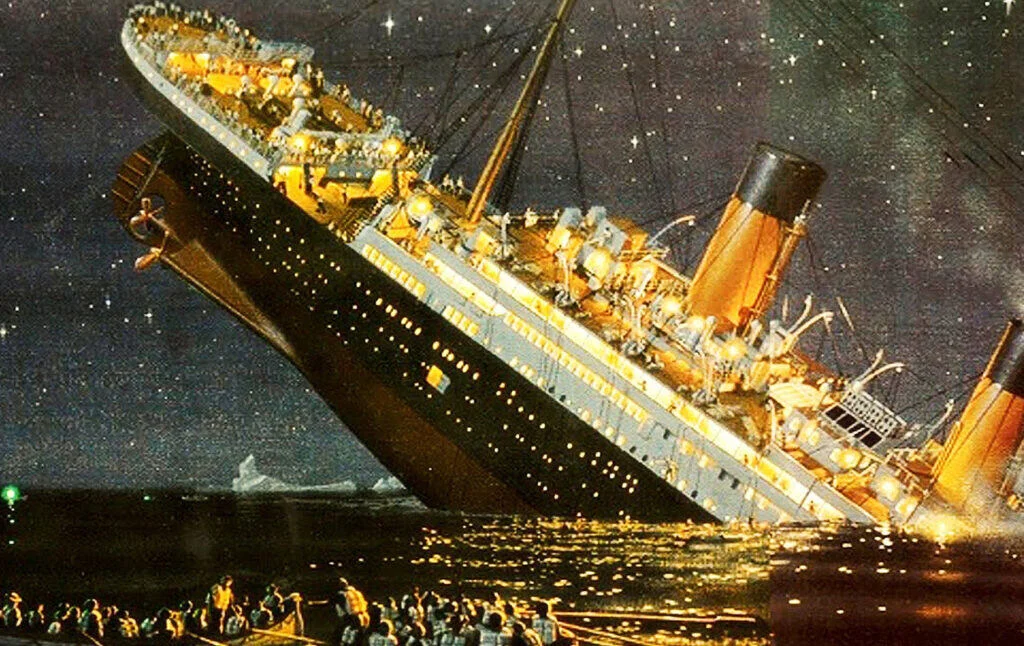 The Titanic’s final moments, in an artist’s impression
Shortly before two in the morning on 15 April 1912, the Titanic had been sinking for over two hours. Her bow was settling lower into the North Atlantic by the minute, the last lifeboats were going over the side, and distress rockets had been going up for most of the past hour. She had around half an hour left.
In a small cabin on the boat deck, the wireless operator Jack Phillips had been calling for help for an hour and a half. Then, through his headphones, came a question from a German liner:
FRANKFURT TO TITANIC: WHAT IS THE MATTER WITH YOU?
Phillips replied:
TITANIC TO FRANKFURT: FOOL. YOU FOOL. STAND BY. STAND BY. STAND BY AND KEEP OUT. KEEP OUT.
It sounds almost comical. There was nothing comical about it.
You can watch the whole night’s messages play out in real time in this video, which starts at the Frankfurt exchange, around 1:50 a.m. I can’t remember how I first stumbled on it, but I come back to it every so often. It’s weirdly fascinating.
The story of the Titanic is usually told as the story of an iceberg. But it is also the story of the night the world discovered what it meant to be connected, and how far “connected” was from “understood”.
Three dots
For most of history, once a ship dropped below the horizon, it was gone. Cables already ran under the oceans, but a ship in mid-Atlantic couldn’t plug into one. If something went wrong out there, nobody would know until you failed to arrive.
Then came Guglielmo Marconi. He didn’t discover radio waves, but he saw what they were for: a message with no wire at all. In December 1901 he announced that a signal from Cornwall had been heard in Newfoundland. It was a single letter in Morse code. S. Three dots.
Historians still argue about whether he really heard it through the static. It hardly matters. Within a decade, the ocean had stopped being a wall, and the same technology was sitting in a cabin on the Titanic.
The most expensive chat in the world
The Titanic’s wireless was the feature everyone talked about. You could be three days from land, nothing but grey water in every direction, and send a telegram home. Or to your broker. Or to the friend meeting you in New York, to let them know you’d be on time. At twelve shillings and sixpence for the first ten words, plenty of first-class passengers did exactly that.
The set was run by two young men, Jack Phillips, 25, and Harold Bride, 22. They weren’t really crew. They worked for the Marconi Company, and most of their job was paying traffic: passengers’ telegrams, stock prices, personal messages.
That was the problem nobody had thought hard about. Ice warnings from other ships came in on the same set, on the same frequency, to the same tired operator, mixed in with someone’s dinner plans. There was no rule about which came first.
The set had broken down on the Friday night, and the two of them spent hours fixing it. By Sunday evening there was a backlog of messages, and the shore station at Cape Race in Newfoundland was finally in range. Phillips sat down to clear the queue.
“Shut up, I am working Cape Race”
Around 11 p.m., a message cut in from the Californian, a nearby steamer that had stopped for the night because of ice. Her only operator, Cyril Evans, tapped out, in the friendly style operators used with each other: say, old man, we are stopped and surrounded by ice.
The Californian was so close that her signal came through Phillips’s headphones like a shout, drowning out Cape Race. Phillips, with a stack of telegrams still to send, snapped back: shut up, shut up, I am busy, I am working Cape Race.
Evans listened a while longer, heard nothing for him, and at about 11:30 p.m. switched off his set and went to bed. He had been on duty for sixteen hours, and nothing said he had to keep listening.
Ten minutes later, the Titanic hit the iceberg.
The warning had been sent. The ship that needed it had heard it. It made no difference at all.
CQD, and something new
A little after midnight, Captain Smith put his head into the wireless cabin and told them to call for help. Phillips began sending CQD, the Marconi distress call, with the ship’s call sign and position.
Bride, standing behind him, suggested he try the new international signal as well: SOS. British operators had mostly ignored it. Bride’s joke, as he told it later, was that this might be Phillips’s last chance to send it.
· · · — — — · · ·
The Titanic wasn’t the first ship to send SOS. She was the one that made the world remember it.
“You fool”
The first ship to answer was the Frankfurt. Her signal was loud and clear, so she sounded close. Phillips sent the position and waited, while her operator went off to find his captain.
Meanwhile, everyone else was calling at once: the Carpathia, the Olympic, the Baltic, the Mount Temple. Phillips was working all of them on a set that could only talk to one at a time, while the floor tilted under his chair.
Much later, the Frankfurt came back with the question at the top of this post. The exact words vary between retellings, but the meaning was clear.
The German press called it rude. But put yourself in that chair. The ship is sinking. You are trying to hold on to the one ship that has said it is coming. And someone who was given everything he needed long ago is back, asking you to explain.
The Frankfurt turned out to be around 140 miles away, far too far to help. But nobody in that cabin could have known that. A loud signal told you nothing reliable about distance, and there was no system for deciding whose questions mattered most. The world had built a way for ships to talk across hundreds of miles. It hadn’t yet built a way for them to be understood.
The ship that was listening
The Carpathia’s operator, Harold Cottam, shouldn’t have been listening at all. His shift was over. He was at his set with his boots off, about to go to bed, when he thought he’d let the Titanic know she had messages waiting at Cape Race.
The reply was the distress call.
Cottam ran to wake his captain, Arthur Rostron, who turned the ship around without waiting to confirm and pushed her faster than she was built to go, through the same ice. She was 58 miles away. It took four hours. By the time she arrived, the Titanic was gone. She picked up about 705 people from the lifeboats. More than 1,500 others had died.
The wireless hadn’t saved the Titanic. But without it, those 705 would have been drifting in an empty ocean, waiting for a ship that had no reason to come.
Keep the signal going
At about 2:05 a.m., Captain Smith came to the wireless cabin and released the two men. You have done your duty. It is every man for himself.
Phillips kept sending.
Bride went to get their lifebelts and came back to find a stoker trying to take Phillips’s off his back while Phillips, headphones still on, kept tapping. They left only when the power died. Bride survived, half frozen, on an upturned lifeboat. He later sold his story to the New York Times for a thousand dollars, which is why we know most of this.
Phillips didn’t make it. He was 25. For nearly two hours, on a sinking ship, he had done one thing: keep the signal going.
The rules written that spring
The inquiries that followed spent a surprising amount of time on the wireless, and the fixes came fast. Later in 1912, an international convention made SOS the single distress signal, required ships to keep a wireless watch around the clock, and gave distress calls priority over everything else. Wireless stopped being a luxury for sending dinner plans and became something no ship could sail without.
It’s a reminder of how unpredictable new technology can be. When Marconi sent three dots across the Atlantic in 1901, he was chasing a business: messages without wires, for shipping lines, newspapers and governments. I doubt he imagined that eleven years later, his invention would be the only thing standing between 705 people and an empty ocean.
Marconi himself had been offered free passage on the Titanic, but sailed for New York a few days earlier on the Lusitania. He was waiting on the dock when the Carpathia arrived, and went aboard to see Bride. Back in Britain, the Postmaster General said that those who had been saved had been saved through one man: Mr Marconi.
Three dots, three dashes, three dots
In 1901, three dots crossed the Atlantic and told the world that distance was no longer the end of the conversation.
In 1912, three dots, three dashes and three dots went out from a sinking ship, and the world learned the rest of the lesson: a signal is only half of a message. Somebody has to be listening. Somebody has to understand. And when everyone is talking at once, somebody has to decide who goes first.
The Titanic’s signals were heard by a ship 58 miles away that raced through the ice to reach her. They were missed by a ship a few miles away, where the only man who could have heard them was asleep.
Both of those things are the story.
If you’d like to explore further, I really recommend The Race to Save the Titanic. Like most topics I get into, it started with a good YouTube video, and I naturally ended up delving deeper. I’ve got a lot of history rattling around in my head, and writing some of it up recently has been surprisingly soothing.