Sola Fide
How One Man’s Obsession with Salvation Helped Change Western Civilisation
For reasons you’ll see later, and a little like Luther himself, I couldn’t stop thinking about this one.
Few individuals have influenced Western civilisation as profoundly as Martin Luther.
His ideas would help fracture the religious unity of Europe, challenge the authority of the Catholic Church and contribute to more than a century of religious conflict, culminating in the Thirty Years’ War. That particular catastrophe began in 1618 with the wonderfully named Second Defenestration of Prague, when Protestant nobles threw two Catholic officials and their secretary out of a castle window.
And yes, it really was the second. Apparently, throwing political opponents out of windows was something of a tradition in Prague. There is even a whole Wikipedia page dedicated to people being thrown out of windows there. I’ll keep that in mind next time I visit.
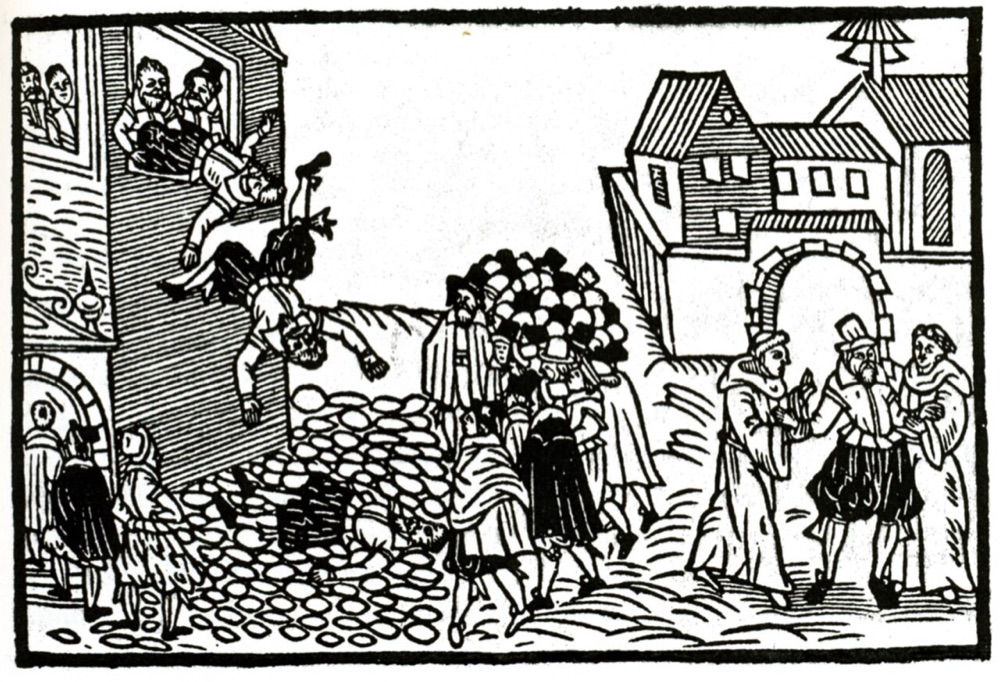 The Defenestration of Prague, from a broadsheet printed in 1618

What followed was far from comical. The Thirty Years’ War became one of the most destructive conflicts in European history. Millions died, and some parts of the German lands lost a third or more of their population to fighting, famine and disease.
It began as a war of religion, but it didn’t end as one. By the 1630s, Cardinal Richelieu had taken Catholic France into the war against the Catholic Habsburgs, putting the interests of the state ahead of the faith.
When the war finally ended in 1648, the Peace of Westphalia left each ruler, not Rome, to decide matters of religion within their own borders. It is often seen as the birth of the modern system of sovereign states, and in World Order, Henry Kissinger argues that it still underpins the balance of power today.
Yet the man whose ideas helped set these extraordinary events in motion had never intended to start a revolution.
He had simply wanted to save his soul.
A Thunderstorm and a Tormented Conscience
In July 1505, a young law student was caught in a violent thunderstorm near the German village of Stotternheim. Terrified that he was about to die, he cried out to St Anne, promising that if he survived, he would become a monk.
He survived, abandoned his legal studies and entered an Augustinian monastery. It was a decision that would change Western history.
But Luther was a deeply troubled man. He examined his conscience relentlessly, confessed his sins exhaustively and struggled with the terrifying possibility that, however hard he tried, he might never be sufficiently righteous before God.
As someone who has OCD, and has lived with it my entire life, I have always found Luther’s accounts of his spiritual struggles particularly fascinating. There is something strangely familiar in his relentless self-examination, his fear of having overlooked some transgression, and his apparent inability to find reassurance, however earnestly he sought it.
Of course, diagnosing a sixteenth-century monk with a modern psychiatric condition would be anachronistic. Yet I cannot help recognising patterns of thought that resonate deeply with my own experience.
For Luther, the question was not whether he had done enough to satisfy himself, but whether he had done enough to satisfy God. And the stakes, as he understood them, were eternal.
Rome: Get On With It!
Around 1510, Luther travelled to Rome on business for his Augustinian order. For a young monk consumed by questions of sin and salvation, visiting the spiritual heart of Christendom must have been an extraordinary experience.
Yet he was appalled by what he regarded as the irreverence of the Roman clergy. He later recalled that while he was carefully celebrating Mass, another priest, impatient with the time he was taking, urged him to hurry along.
“Get on, get on!”
The contrast is almost comical. Here was a man agonising over the smallest transgression, terrified of failing to approach God with sufficient reverence, being told by a fellow priest to get on with it.
Even more shocking was Luther’s later account of priests irreverently mocking the words of consecration during Mass, substituting:
“Panis es, et panis manebis; vinum es, et vinum manebis.”
“Bread thou art, and bread thou shalt remain; wine thou art, and wine thou shalt remain.”
For a man who believed profoundly in the sacred nature of the Eucharist, such words must have seemed almost unimaginable. He could not simply go through the motions.
Sola Fide
At the heart of Luther’s struggle lay a deceptively simple question: how could a sinful human being stand righteous before God?
The more he examined his conscience, the more inadequate he felt. If salvation depended upon his own righteousness, how could he ever be certain he had done enough?
Through his study of Scripture, particularly St Paul’s Letter to the Romans, Luther came to understand justification as a gift of divine grace, received through faith rather than earned through human merit.
Sola fide.
By faith alone.
Good works remained important, but they were the consequence of faith, not the means of earning salvation.
For a man tormented by the question of whether he had done enough, this changed everything. Luther’s answer to “have I done enough?” was, in effect, to stop asking. It had never depended on him.
I’m not a religious person, but I’ve always found Luther fascinating. You don’t need to share his faith to recognise the question he was asking, or to understand why his answer mattered so much to him. To a mind that tends to ask the same question over and over, I can see why that answer would feel like such a release.
An Unintended Revolution
In 1517, Luther challenged the sale of indulgences. The Church taught that indulgences could reduce the punishment due for sin, for the living or for souls already in purgatory. By Luther’s time, they were being sold to help pay for the rebuilding of St Peter’s Basilica in Rome. One preacher, Johann Tetzel, was said to promise:
“As soon as the coin in the coffer rings, the soul from purgatory springs.”
For a man who had spent years agonising over whether he could ever do enough to be saved, the idea that forgiveness could simply be bought must have been intolerable.
On 31 October 1517, he set out his objections in the Ninety-five Theses. Tradition has him nailing them to the door of the Castle Church in Wittenberg, although historians still debate whether that really happened. Either way, thanks to the printing press, they spread across Germany within weeks, setting in motion a theological dispute that would ultimately fracture Western Christianity.
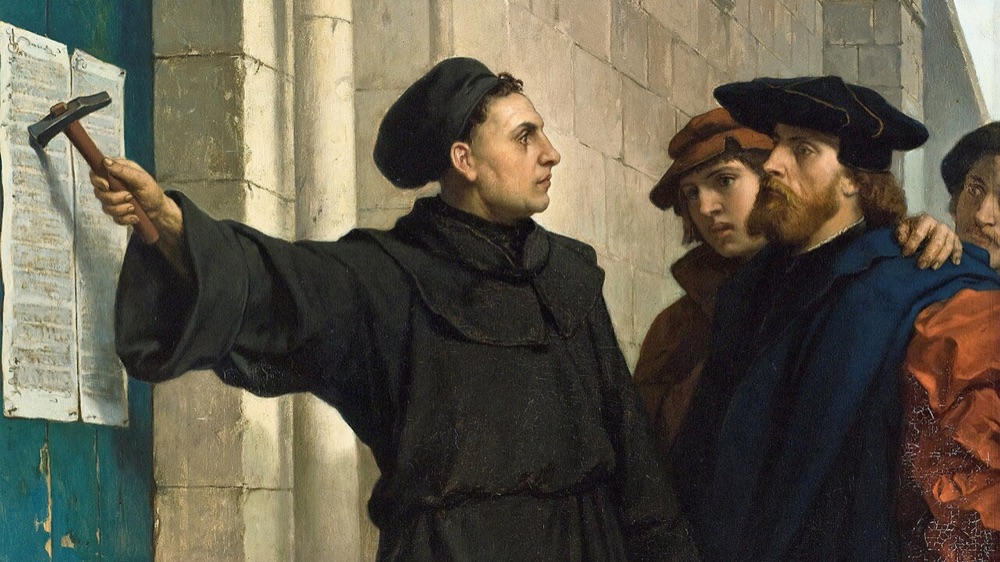 Luther posting the Ninety-five Theses, Ferdinand Pauwels, 1872. Whether or not it happened quite like this.

He had not intended to establish a new Church. He wanted to restore what he believed to be authentic Christian teaching.
Yet his insistence that Scripture, rather than the institutional Church, was the ultimate authority in matters of faith raised a far more consequential question: who had the right to determine religious truth?
In 1521, summoned before the Diet of Worms, Luther refused to retract his writings unless convinced by Scripture and reason.
The consequences extended far beyond anything he could have imagined. The Reformation reshaped European politics, challenged established religious authority and contributed to centuries of debate about conscience, toleration and the relationship between Church and state.
There is a remarkable irony here. A man who desperately sought religious certainty helped create a Europe in which religious authority itself became increasingly contested.
Luther was no saint. He had deep flaws, and some of his later writings are rightly condemned today. Yet the consequences of an idea are not confined to the intentions of the person who first articulates it.
An Unintended Technological Revolution
There’s another side to Luther’s story that, as a software engineer, I find hard to ignore.
Johannes Gutenberg had begun printing with movable type in Mainz around 1450, little more than half a century earlier. Luther was one of the first people to understand what it could really do.
Rather than long Latin treatises for scholars, he wrote short, sharp pamphlets in German, for anyone who could read them, or hear them read aloud. By some estimates, his writings made up around a third of all German-language books sold between 1518 and 1525. His German New Testament, published in 1522, put Scripture into the hands of ordinary people and helped shape the German language itself.
A century earlier, Jan Hus had raised many of the same objections to the Church. He was burned at the stake in 1415, and his ideas, while they survived, never swept across Europe. (Hus was from Prague, and in 1419 his followers carried out the first Defenestration of Prague. It really was a tradition.)
Luther’s ideas were different. By the time the authorities could respond, thousands of copies were already in circulation.
It’s something interesting to consider with AI today. A new technology arrives, and suddenly ideas can be produced and spread far faster than ever before. The people who understand it first gain an enormous advantage. Luther didn’t invent the printing press, but he was arguably its first great user.
The Man Who Wanted to Save His Soul
What continues to fascinate me about Luther is the extraordinary distance between the intensely personal origins of his struggle and its historical consequences.
A young man frightened by a thunderstorm enters a monastery.
A monk tormented by his conscience searches for salvation.
A theologian arrives at the conviction that righteousness comes through faith, not human merit.
And a century later, men are being thrown out of windows in Prague as Europe descends into war.
History, of course, is never quite that simple. But the paradox remains.
Martin Luther never set out to change the world.
He sought peace for his conscience.
And in doing so, he helped change the world.
If you’d like to go deeper, I really recommend PBS’s documentary on Martin Luther. It’s two hours long, but worth every minute.