“And Grievously Hath Caesar Answer'd It…”
I’ve been catching up on my reading recently, and picked up Shakespeare’s Julius Caesar (as you do). I’ve always been struck by Mark Antony’s famous “Friends, Romans, countrymen” speech. Every time I hear or read it, I’m overcome by an emotion I can’t quite put into words. It’s a rare thing to find a piece of literature that can move you so deeply, no matter how many times you’ve encountered it.
The trouble I’ve always had, though, is explaining to someone else why it’s so powerful. So this is my attempt.
I’m also trying to get better at writing, and I thought there’d be no better way to practise than by exploring something written so well. Writing this, I realised just how much I enjoy Shakespeare.
There’s plenty more on my list. I’ve tried others, like Henry V and Macbeth, but they never quite stuck. When you find the one that does, though, it really sticks.
My first encounter with the speech was through this extraordinary performance by Damian Lewis. I remember sitting in my flat during COVID, watching this one clip, completely captivated. His delivery, the words themselves, and the emotion behind them have stayed with me ever since.
I was so taken by it that I ended up learning the speech off by heart. A pretty cool party trick, by the way. I once performed it for a friend in the Shakespeare pub in London. The irony wasn’t lost on me.
For those unfamiliar with the history, Julius Caesar was assassinated on the Ides of March, 44 BC, by a group of Roman senators, including Brutus and Cassius. They believed Caesar’s growing power threatened the Roman Republic, and that his death would restore its liberty.
In Shakespeare’s telling, Caesar’s final moments are immortalised by one of the most famous lines in literature. Upon seeing Brutus, a man he trusted, among his assassins, Caesar utters:
“Et tu, Brute? Then fall, Caesar!”
You too, Brutus?
There’s something heartbreaking about the simplicity of it. Surrounded by enemies, it’s the betrayal of a friend that finally breaks him.
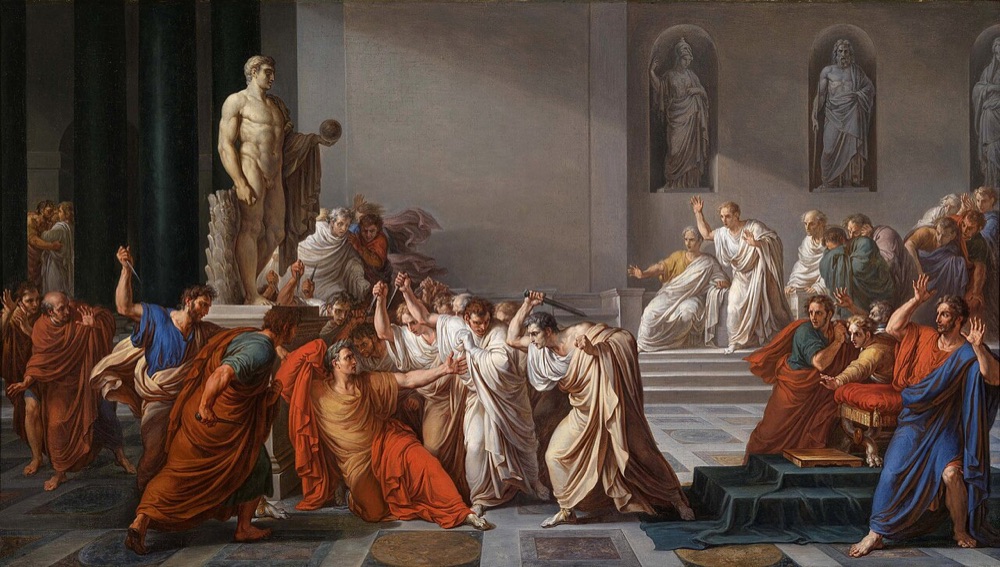 The Death of Julius Caesar, Vincenzo Camuccini
I think most of us have seen this one in meme form, which is great too. But even after all the memes, I still find it a striking painting. That says a lot about Camuccini’s skill, and about how powerfully Shakespeare’s telling of the moment has endured.
And yet the conspirators got the opposite of what they wanted. Caesar’s assassination would help bring about the very thing they feared: the end of the Republic and the eventual rise of the Roman Empire.
But what has always fascinated me is that, in Shakespeare’s telling, the assassination itself isn’t really the centrepiece. It’s what happens afterwards.
Mark Antony stands before the Roman people, with Caesar’s body before him, and delivers what I consider one of the greatest speeches ever written. Before long, he’s holding up Caesar’s toga to the crowd, still marked by the conspirators’ daggers.
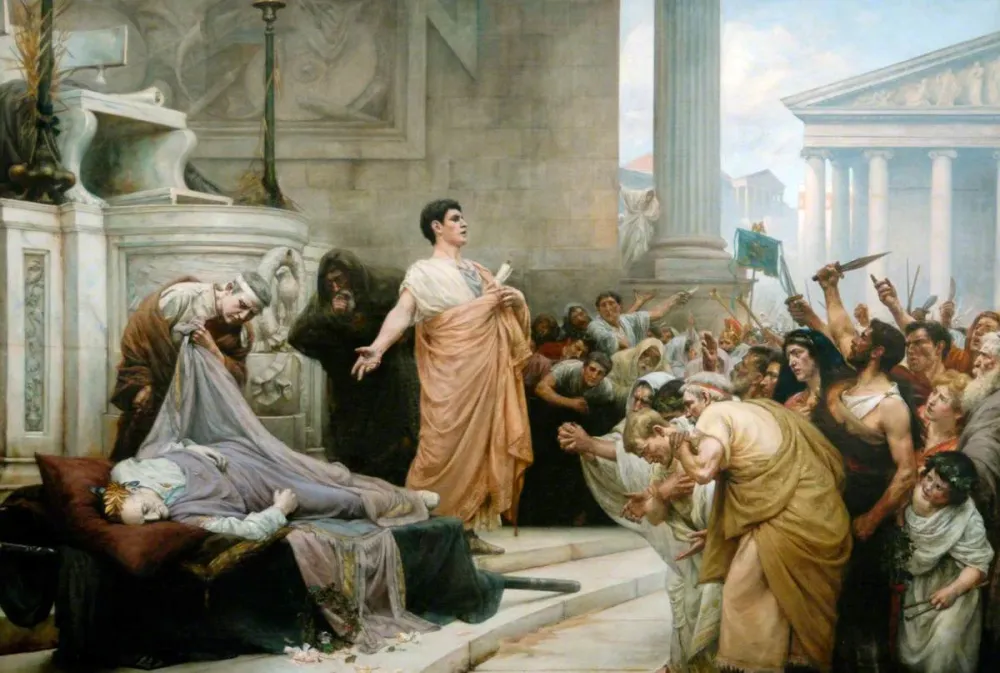 Mark Antony’s Oration over the Body of Caesar, via World History Encyclopedia
(If you want to read further, World History Encyclopedia has a great piece on Mark Antony’s oration at Caesar’s funeral.)
And it begins:
“Friends, Romans, countrymen…”
Friends, Romans, countrymen, lend me your ears;
I come to bury Caesar, not to praise him.
The evil that men do lives after them;
The good is oft interred with their bones;
So let it be with Caesar.
What an opening.
Antony begins by presenting himself as a grieving friend, not a political opponent. He claims he has come merely to bury Caesar, not praise him. Of course, he proceeds to do precisely the opposite.
Even the opening address is deliberate. Friends first, Romans second, countrymen third. He appeals to their personal connection before their shared identity.
“For Brutus is an honourable man…”
The noble Brutus
Hath told you Caesar was ambitious:
If it were so, it was a grievous fault,
And grievously hath Caesar answer’d it.
Here, under leave of Brutus and the rest—
For Brutus is an honourable man;
So are they all, all honourable men—
Come I to speak in Caesar’s funeral.
This is where Shakespeare’s genius really begins to show.
Antony doesn’t openly challenge Brutus. Instead, he introduces the smallest seed of doubt: “If it were so.”
And then, that wonderful repetition: “Brutus is an honourable man.”
Initially respectful, but as the speech progresses, those same words become increasingly sarcastic. Antony manages to undermine Brutus without ever explicitly calling him a liar.
“Did this in Caesar seem ambitious?”
He was my friend, faithful and just to me:
But Brutus says he was ambitious;
And Brutus is an honourable man.
He hath brought many captives home to Rome
Whose ransoms did the general coffers fill:
Did this in Caesar seem ambitious?
When that the poor have cried, Caesar hath wept:
Ambition should be made of sterner stuff:
Yet Brutus says he was ambitious;
And Brutus is an honourable man.
Now Antony begins to remind the crowd of everything Caesar had done for Rome.
His military victories brought wealth to the Republic. He cared for the poor. He was, in Antony’s telling, a faithful and generous man.
And then that simple question: “Did this in Caesar seem ambitious?”
Antony doesn’t tell the crowd what to believe. He makes them question what they’ve already been told.
“Was this ambition?”
You all did see that on the Lupercal
I thrice presented him a kingly crown,
Which he did thrice refuse: was this ambition?
Yet Brutus says he was ambitious;
And, sure, he is an honourable man.
Perhaps the most devastating argument of all.
The conspirators justified their actions by claiming he sought to make himself king. Yet Antony reminds the crowd that Caesar had publicly refused a crown three times.
“Was this ambition?”
It’s a brilliant piece of rhetoric. The crowd are being asked to weigh their own memories against Brutus’s accusations.
And again, that refrain: “Brutus is an honourable man.” By now, it’s difficult to read those words as anything other than an accusation.
“My heart is in the coffin there with Caesar…”
I speak not to disprove what Brutus spoke,
But here I am to speak what I do know.
You all did love him once, not without cause:
What cause withholds you then, to mourn for him?
O judgment! thou art fled to brutish beasts,
And men have lost their reason. Bear with me;
My heart is in the coffin there with Caesar,
And I must pause till it come back to me.
This is my favourite part of the entire speech.
The words “But here I am to speak what I do know” particularly move me, especially in Damian Lewis’s performance.
Throughout the speech, Antony has been holding himself together. He stands before the crowd, carefully choosing his words, concealing his grief and anger behind a mask of composure, holding back his tears, something Damian Lewis demonstrates so well. He must appear respectful towards the very men responsible for his friend’s death.
But as he utters those words, you can almost see that mask begin to crack.
For a brief moment, the restraint slips, and you sense just how much Antony is holding back.
He continues:
“You all did love him once, not without cause.”
What changed? Why have the Romans so readily accepted the death of a man they once adored?
And then comes the masterstroke.
“My heart is in the coffin there with Caesar,
And I must pause till it come back to me.”
He stops.
The crowd, previously sympathetic to Brutus, begins to question the assassination. Antony’s silence gives his words time to settle, and the Romans begin to turn.
It’s a masterful demonstration of the power of rhetoric, but also of the emotion Shakespeare manages to capture. Sometimes the most powerful thing an orator can do is stop speaking.
Perhaps that’s why HBO’s Rome didn’t even attempt to portray the speech. The series is sometimes criticised for it, but I don’t blame them. How do you compete with Shakespeare?
A little history, a little Shakespeare
I think the reason this moment resonates with me so much is that there are so many angles to explore. The political intrigue, the personalities, the competing ideas of liberty and ambition, the betrayal, and the consequences that would shape the course of Roman history. Each has been written about and debated in great depth.
And then there’s Shakespeare, who takes an already fascinating historical event and explores it through the power of language, giving us something that still feels remarkably human more than two thousand years after Caesar’s death.
It’s something I find throughout his work. Another scene that has always stayed with me is Mercutio’s death in Romeo and Juliet. Mortally wounded by Tybalt, after Romeo attempts to intervene in their fight, Mercutio turns to his friend and says:
“Why the devil came you between us? I was hurt under your arm.”
There’s something devastatingly human about that line. No grand speech, no elaborate metaphor. Just the disbelief and accusation of a dying man, directed at the very friend who was trying to protect him. Romeo’s good intentions have led to tragedy, and Shakespeare captures that terrible irony in a single sentence. (Slow Shakespeare has a lovely piece on this moment too.)
I remember first seeing this scene from Baz Luhrmann’s Romeo + Juliet at school and being shocked at how good it was. Harold Perrineau is brilliant as Mercutio, and DiCaprio does a great job too.
And inevitably, as is the tragedy of Romeo and Juliet, Romeo, who moments before had refused to fight, is consumed by fire and fury. He turns on Tybalt:
“Either thou, or I, or both, must go with him.”
As Cambridge’s Slow Shakespeare series perfectly puts it: “No compromise. No way out.”
It’s moments like these that remind me why I love his writing so much. Whether it’s Antony’s heartfelt tribute to a fallen friend or Mercutio’s final exchange with Romeo, Shakespeare has an uncanny ability to capture human nature in a way that feels immediate, even centuries later.
Caesar’s assassination is one of those rare moments where my love of history meets my admiration for Shakespeare.
I’d like to explore more of these stories here, perhaps staying with the Roman theme for a while, although there are plenty of other historical topics I’d love to write about. The Battle of Alesia and Caesar’s march on Rome, including his infamous crossing of the Rubicon, are both near the top of my list.
And perhaps that’s the thing I love most about history. Even when we know how the story ends, there’s always something new to discover in how we got there.
If you love history as much as I do, I can’t recommend Historia Civilis enough. Their video on the Battle of Alesia is one of my favourites, along with the Battle of Agincourt.
For now, though, I’ll leave you with Antony’s words:
“My heart is in the coffin there with Caesar,
And I must pause till it come back to me.”